Add Your Heading Text Here
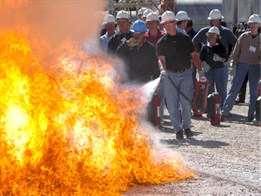
Fire extinguishers are only valuable safety devices when you know how to use them. This is why we offer training in the use of fire extinguishers and provide information on this Web site to help you learn about the ABCs of fire extinguishers, and how to perform visual inspections and decide whether or not to attempt to fight a fire. We encourage you to call us to schedule a fire extinguisher training session today.
Know Your Fire Extinguisher ABCs
Fires are classified based on the type of fuel involved. Likewise, portable fire extinguishers are classified by the type of fires they are designed to extinguish. There are five basic classifications of fuel and extinguishers, and extinguishers are labeled with either letter-shaped or pictorial symbols that indicate what types of fires they are intended for.
Classifications of Fires and Extinguishers
Class A
Class A fires involve ordinary combustible materials, such as cloth, wood, paper, rubber, and many plastics. Extinguishers with an A rating are designed to extinguish fires involving these ordinary combustible materials.
Class B
Class B fires involve flammable and combustible liquids such as gasoline, alcohol, oil-based paints, lacquers. Therefore, extinguishers with a B rating are designed to extinguish fires involving flammable and combustible liquids.
Note: Do not attempt to extinguish a fire involving flammable gas unless there is reasonable assurance the source of fuel can be promptly shut off. In fact, if the only fuel burning is the leaking gas, the best method for extinguishing the fire is to shut off the fuel supply. Extinguishing a flammable gas fire, without shutting off the fuel, will allow unburned gas to escape into the atmosphere, which may permit a dangerous accumulation of gas to develop, and an explosion may occur if the gas is exposed to an ignition source.
Class C
Class C fires involve energized electrical equipment. Extinguishers with a C rating are designed for use with fires involving energized electrical equipment.
Class D
Class D fires involve combustible metals, such as magnesium, titanium, and sodium. Extinguishers with a D rating are designed to extinguish fires involving combustible metals.
Note: Common extinguishing agents may react with a combustible metal fire causing the severity of the fire to increase. The most common method for extinguishing a combustible metal fire is to cover the burning material with a dry powder, such as sand, which will not react with the material. If you store or use combustible metals, contact the Fire Prevention Services office for a consultation regarding the proper type and amount of extinguishing agent you should have available.
Class K
Class K fires involve vegetable oils, animal oils, or fats in cooking appliances. Extinguishers with a K rating are designed to extinguish fires involving vegetable oils, animal oils, or fats utilized in commercial cooking appliances.
Note: Extinguishers with a K rating are normally required where deep-fryers and/or griddles are utilized to prepare large quantities of food. An example would be a commercial kitchen similar to those found in restaurants and cafeterias.
Multipurpose Extinguishers
Most portable extinguishers are rated for use with more than one classification of fire. For example, an extinguisher with a BC rating is suitable for use with fires involving flammable liquids and energized electrical equipment. An extinguisher with an ABC rating is suitable for use with fires involving ordinary combustibles, flammable liquids and energized electrical equipment. An extinguisher that is rated for use with multiple hazards should include a symbol for each hazard type.